


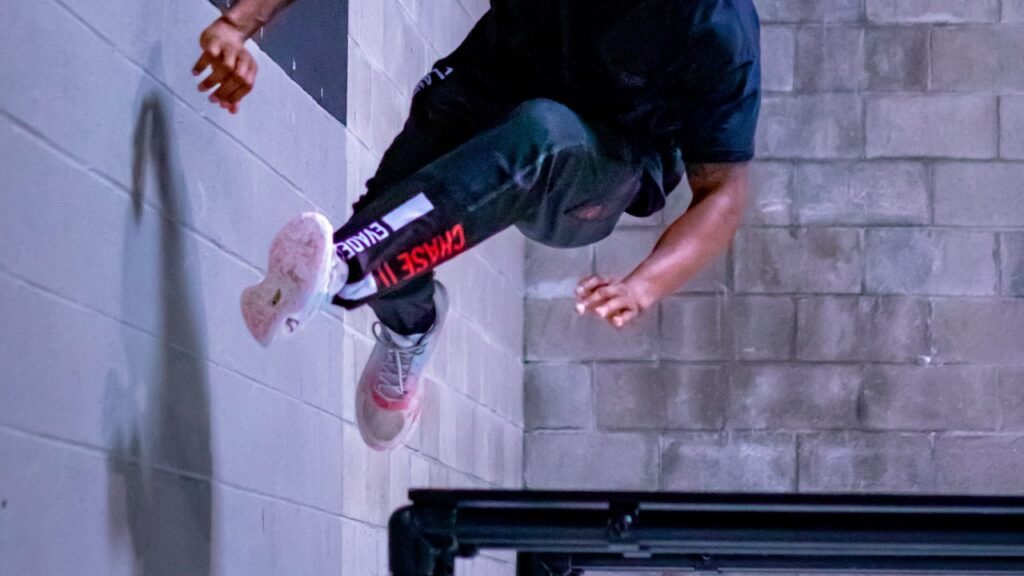
For a rule that takes just a few words to write, “touching the wall is out of bounds,” it might be the most divisive line in the entire World Chase Tag® rulebook. It has existed for years, shaping matches in places like the US Qualifiers & Finals, the French Chase-Off™ circuit, and, most recently, the Rotterdam Chase-Off™. And yet, ask ten people if the rule should still exist and you’ll get eleven answers.
As the sport expands and more gyms build Quads in tight spaces, the conversation has only become louder and more urgent.
Below, we break down the controversy from every angle and leave room for voices from inside the sport.
The Athlete Perspective: Skill, Habit, and a Question of Fairness
For athletes, the wall Out of Bounds (OB) rule splits the field straight down the middle.
Some athletes actually like the rule, typically those who train on Quads that are already close to walls. For them, it’s a familiar constraint, like court boundaries in other sports.
“I’m aligned with how we handled it in Rotterdam on Day 2. You shouldn’t be allowed to use the wall, but if you brush it lightly, that’s fine. That said, part of me wishes we could use it. Imagine tic-tacs or even wall flips becoming part of evasion strategy, it would be insane.”
— Redouan Yagoub, Rooftop Kings captain
But across the field, one concern keeps coming back: clarity. Human movement at full speed is messy. When you’re sprinting, juking, diving, and reacting on instinct, a quick brush against a wall isn’t a tactic, it’s a reflex. It doesn’t create an advantage. It doesn’t meaningfully alter the chase. Yet under the current rule, even an accidental touch can decide the outcome, and that’s where frustration begins.
What many athletes are asking for isn’t the removal of the rule, but a clearer framework that preserves the flow of competition without punishing natural, unavoidable movement.
That’s why some advocate for an “incidental contact” standard. A formal distinction between meaningful use of the wall and harmless, instinctive touch.
“We need a clear distinction for incidental contact. Grazing a wall is completely different from pushing off it or deliberately using it. In Ninja competitions, incidental contact is standard. Refs are trained to recognise it, and it works. Chase Tag® could adopt the same approach. If a ref isn’t sure, they can flag it, let the chase play out, and review it afterward. That way athletes don’t stop mid-chase like we’ve seen before, and fans aren’t left confused. The flow stays clean, and the call stays fair.”
— Tim Dexter, owner of Dexterity Depot
Others push the conversation further. Not toward clearer restriction, but toward adaptation.
“I understand why consistency between competitions matters, but I think restricting the wall actually affects gameplay more than allowing it. Even if I’m wrong, seeing how athletes could creatively use walls would be incredible. Chase Tag comes from a movement culture built on adapting to the environment. If a Quad is surrounded by walls or obstacles, athletes should adapt to that space rather than limit their movement to pretend those elements aren’t there. The sport is still young, and that experimentation feels like part of its evolution.”
— Roland Hannigan, Dexterity Depot athlete & content creator
But even with an incidental-contact framework, one issue remains at the heart of the debate: subjectivity. Did the athlete use the wall? Did they touch it by instinct? How much contact counts as “use”? And what about unavoidable collisions in tight space?
To many athletes, the current wall rule introduces a level of unpredictability that has nothing to do with athleticism and everything to do with interpretation.
The Fan Perspective: Anti-Climax and Mental Pollution
If athletes feel the rule adds uncertainty, fans feel the impact even more sharply. From the stands or the livestream, spectators want uninterrupted action, flow, chaos, creativity, near-tags, miracle jukes, last-second evasions. They want the chase to resolve because one athlete outplayed the other, not because of a technicality.
Yet too often, a chase ends not through brilliance or error, but because a fingertip brushed a wall no one even noticed.
It’s anti-climactic in the purest sense: the play doesn’t conclude with a tag or a heroic evasion, but with a referee’s gesture stopping the action cold.
“Would it not be simpler to keep the wall in bounds? I suppose it doesn't matter so long as it's consistent, but it would be much easier on the referees.”
— @qwertyTRiG on YouTube
The rule also creates awkward mental traps for athletes. Many viewers have seen a chaser touch the wall by accident and immediately stop sprinting, convinced the chase is already lost. Even if the referee wouldn’t have called it, the athlete self-cancels. Fans can see the frustration on their faces, and that frustration becomes part of the viewing experience.
When spectators don’t understand why a chase ended or disagree with the interpretation, trust in officiating starts to erode. And when trust erodes, so does immersion.
The WCT Perspective: Consistency, Identity, and Risk of Mutation
This is where the conversation gets serious.
Because for WCT organisers and referees, this isn’t just a question about walls it’s a question about the identity of the sport. At official tournaments (Worlds, Continentals, Nationals) the Quad™ is always placed far away from any obstacles. The environment is controlled, neutral, and intentionally designed to highlight pure movement.
But in gyms around the world, space is expensive. Many facilities place the Quad™ against one, two, or even three walls to save cost and floor space.
The choice is understandable. The consequences are not always simple.
If walls are allowed, if touching them becomes legal, athletes may start using them tactically. Wall-runs, tic-tacs, momentum redirects, rebounds. Movements that look spectacular, but also movements that simply wouldn’t exist on the main stage.
And here lies the problem.
If athletes train with walls as valid tools, fans will eventually demand it at official tournaments. And if fans demand it, WCT will face enormous pressure to redesign the Quad™ entirely.
That would mean:
- New Quad™ dimensions
- New safety standards
- New competition rules
- And a requirement for every licensed gym worldwide to update their Quad™ or risk being non-compliant.
That’s not just a rule tweak, that’s a global infrastructure change. WCT’s challenge is to protect both the purity and the scalability of the sport. The wall rule may feel restrictive, but removing it could unleash a domino effect that fundamentally shifts what Chase Tag® looks like in the long run.
Where Do We Go From Here?
The wall Out of Bounds rule is not going away tomorrow. But the conversation is evolving faster than ever, driven by:
- More gyms with space limitations
- More competitions in varied environments
- More athletes entering the sport
- More fans demanding transparency
- And more pressure on WCT to standardise without stagnating
Some potential futures:
- Keep the rule but add stricter, clearer wording
- Legalise wall contact but restrict wall usage
- Mandate minimum clearance around all Quads
- Create a “wall-friendly” training category distinct from official competition
No option is perfect. Each one shifts the sport in a different direction.
The one certainty is this: As Chase Tag™ grows, the sport can no longer avoid this debate. The wall rule sits at the intersection of athlete safety, competitive fairness, spectator experience, and global scalability.
It is not just a technical footnote, tt is a fork in the road and sooner or later, someone will have to decide which path the sport takes.
And now, it’s your turn.
What do you think? Should walls count as out of bounds or is it time for the sport to evolve?
Share your opinion in the comments or on socials, tagging @Quadside_ so the debate reaches the whole community.