


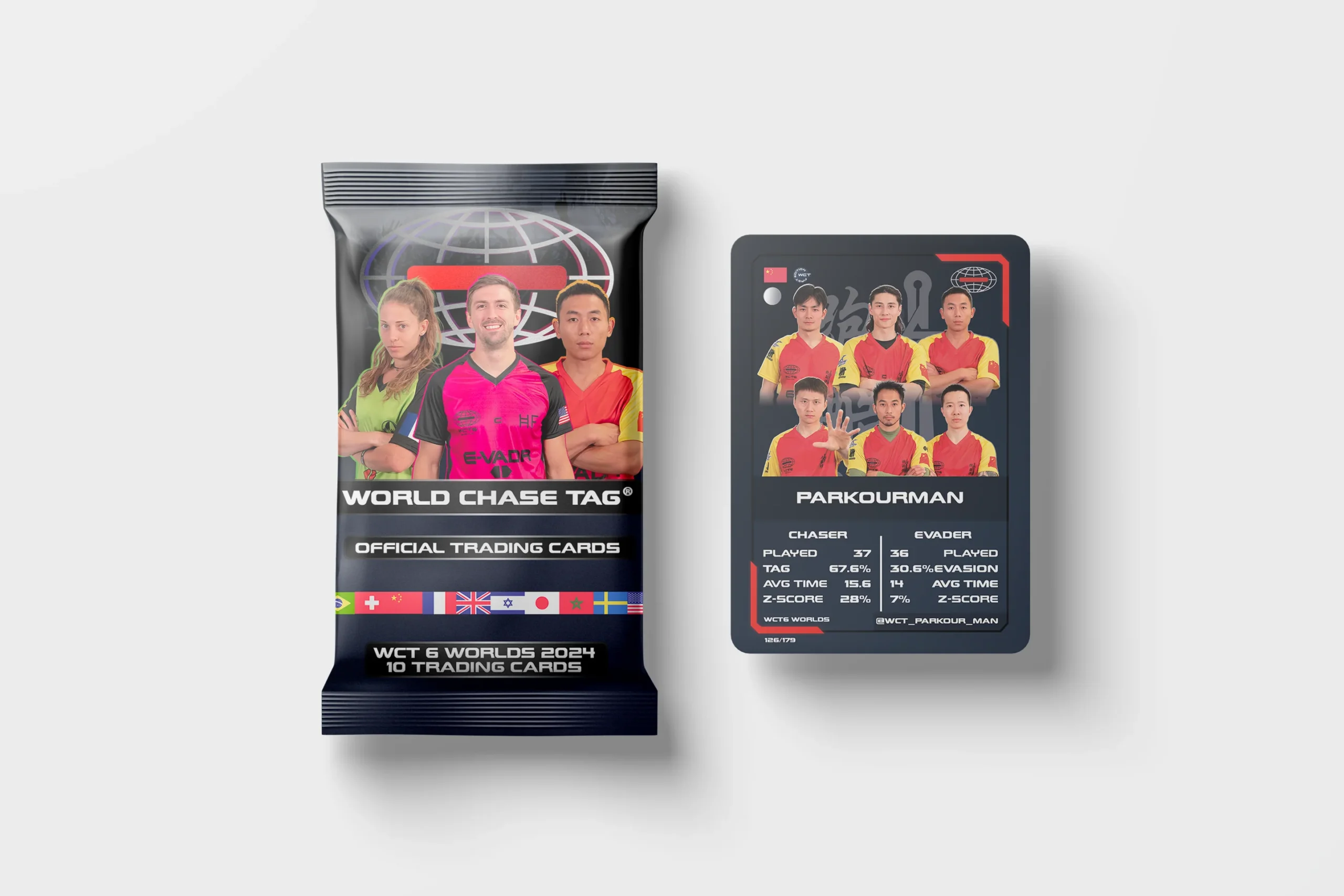
When World Chase Tag® released the WCT6 Worlds trading card set, it wasn’t the organisation’s first attempt at turning competition into a collectible format.
Earlier in its history, WCT had already explored trading cards after a US Championship, in a project impulsed by @MarcusMeadpk who was working with WCT at the time.
The WCT6 Worlds cards build directly on that early foundation. The design language remains deliberately similar, preserving continuity, while the scope, structure, and data depth have expanded. According to WCT officials, that US Championship project laid the groundwork for what is now intended to become a recurring trading card series for every World Championship, starting with WCT6.
What changed with WCT6 was not the idea of trading cards itself, but the intent behind them: this was no longer an isolated experiment, but the first fully structured step toward a long-term archival series tied to the sport’s premier event.
A Complete Set: 184 Cards

The WCT6 Worlds trading card set consists of 184 total cards:
- 179 standard cards
- 5 secret cards
Every card corresponds to a team, an athlete, or a specific distinction from Worlds.
In that sense, the WCT6 Worlds set follows a logic familiar to fans of established sports collectibles: comprehensive coverage without artificial inflation.
How the Set Is Structured
At the foundation of the set is a simple, consistent rule applied to every team. One non-holo card per athlete, including the team captain. One Team Captain holo card. One Team holo card.
Crucially, this structure applies equally across teams, ensuring that baseline representation is consistent and that higher tiers are earned rather than assigned.
Some teams stopped at the baseline. Others didn’t.
Rarity, Designs, and Print Quantities
Scarcity in the WCT6 Worlds trading card set is clearly structured, but it is not immediately transparent to the public. While rarity tiers are visible on the cards themselves, the exact number of designs and print quantities were not formally published at release.
To understand the real level of scarcity behind each tier, additional clarification was required from WCT officials, alongside community-led documentation. This level of clarity would not have been possible without the work of members of the official World Chase Tag® Discord, who meticulously compiled, cross-checked, and organised card data over time. In particular, @JordanMD and @Infraggable played a central role in documenting the full set, helping transform scattered information into a coherent and reliable reference for collectors and fans alike.
The data below reflects that combined effort: a clearer picture of how rarity was actually engineered within the set.
| Rarity Tier | Finish Type | Number of Designs | Print Quantity per Design |
|---|---|---|---|
| Bronze (Holo) | Holo | 17 | 60 |
| Bronze (Non-Holo) | Non-Holo | 54 | 76 |
| Silver (Holo) | Holo | 16 | 55 |
| Silver (Non-Holo) | Non-Holo | 36 | 82 |
| Gold (Holo) | Holo | 7 | 30 |
| Gold (Non-Holo) | Non-Holo | 28 | 30 |
| Diamond (Holo) | Holo | 5 | 42 |
| Diamond (Non-Holo) | Non-Holo | 7 | 35 |
| Full Art | Holo | 7 | 9 |
| MVP | Rare Holo | 2 | 15 |
Not All Holo Cards Are Equal
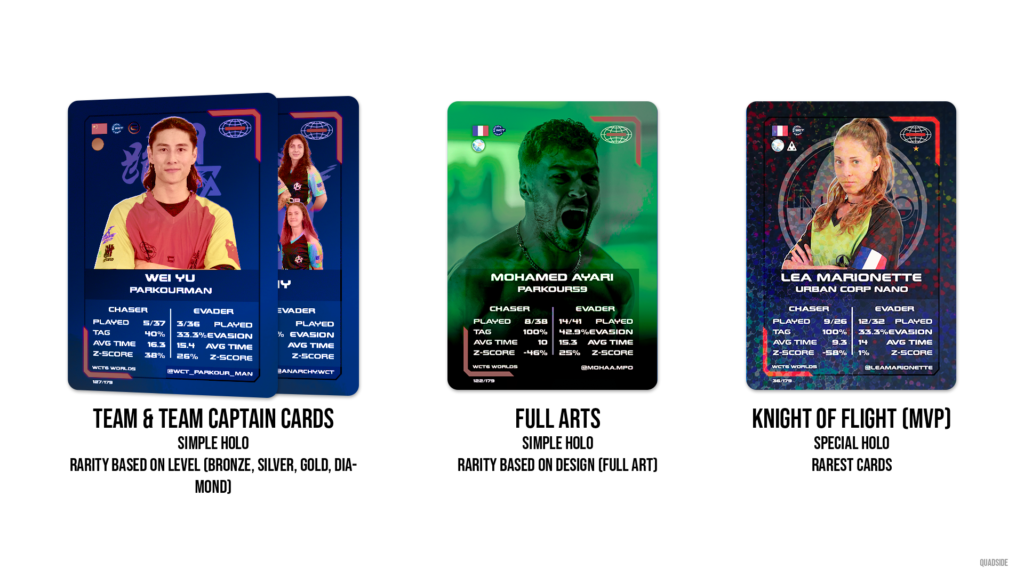
A common misconception among newer collectors is to treat “holo” as a single rarity tier. In the WCT6 Worlds set, that isn’t the case.
In the WCT6 Worlds set, “holo” should be understood as a finish rather than a tier. Full Art cards also use a holographic finish, but represent a distinct design and recognition level, while MVP cards sit above both, featuring a unique holo treatment reserved for the most exceptional performances. In other words, while all Full Arts are holo, not all holo cards are Full Arts and MVP cards occupy a category of their own.
The Top of the Pyramid: MVP Cards
At World Championship level, the Knight of Flight designation functions as the equivalent of an MVP award in Chase Tag®, making these two cards the highest individual honours represented in the set.
- Lea Marionette (Nano)
- Benjamin Garcia (KIMEO)
These are the rarest cards in the entire collection. They are not simply diamond variants, nor upgraded versions of existing designs. They are standalone recognitions of exceptional Worlds performances.
There are only two. That exclusivity is intentional.
Full Art Cards: Performance, Not Popularity
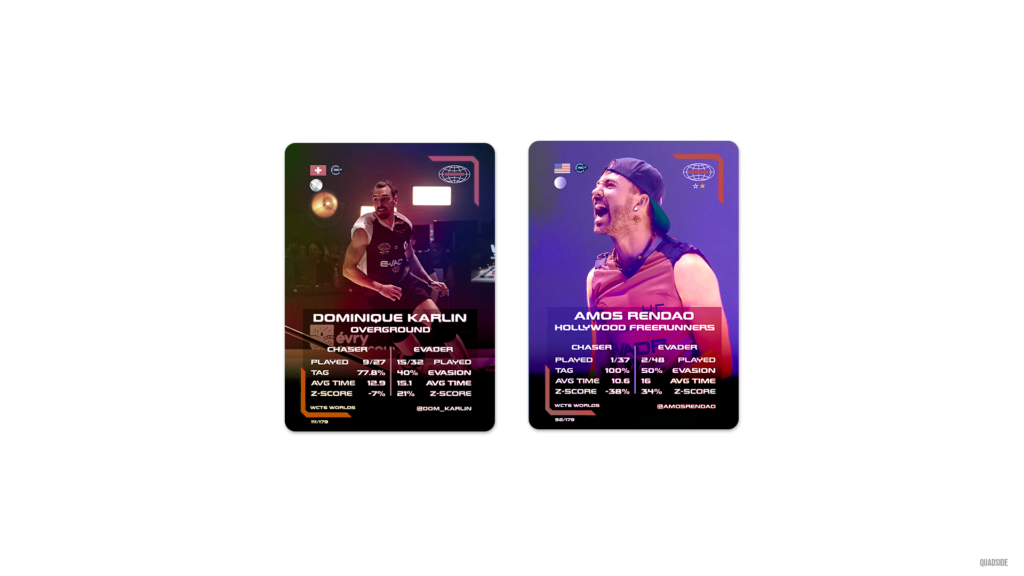
Just below MVP level sit the Full Art cards, all holo, and limited to seven designs: Benjamin Garcia (KOF), Lea Marionette (KOF), Ky Baldwin, Dominique Karlin, Tiana Webberley, Mohamed Ayari (all Diamonds) & Amos Rendao.
With one notable exception, every Full Art card belongs to a diamond-level athlete.
That exception is Amos Rendao. His inclusion explains a lot about how this set thinks about legacy. Amos earned a Full Art not because of a single event, but because he became the first athlete to win Worlds twice, with two different teams.
Full Arts, in this set, are not stylistic upgrades. They are acknowledgements.
What’s Actually on the Cards
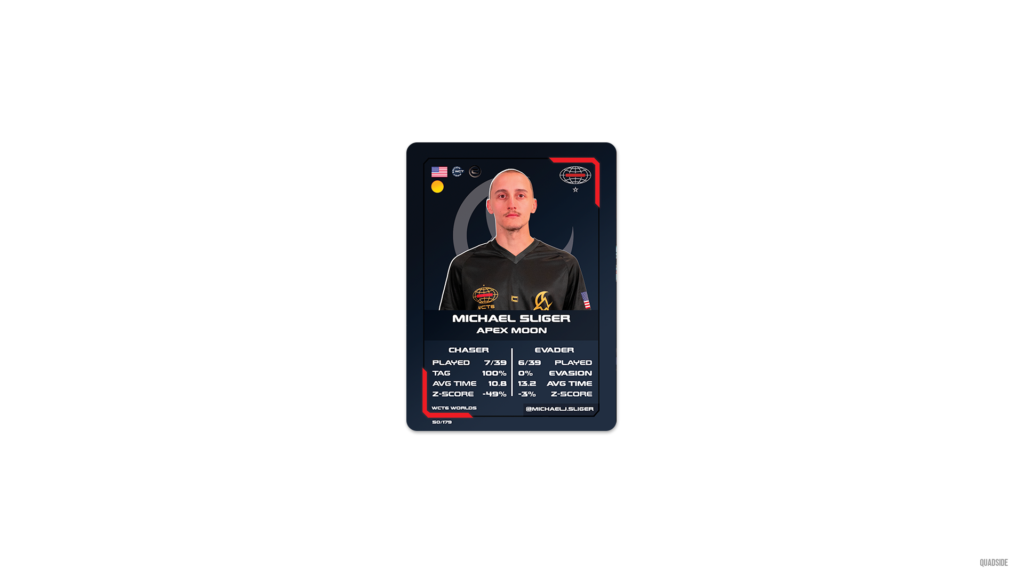
Cards carry a dense amount of competitive information:
- Rarity icon (bronze, silver, gold, diamond)
- Country flag
- First Edition stamp
- Athlete name, team name, and team logo (on the back)
And crucially, performance statistics.
Chaser stats include: Chases played (e.g. 4 / 16), Tag ratio (%), Average tag time (to tenths of a second) & Z-score from –100% to +100% (Lower is better: faster tags than the field average)
Evader stats include: Evasions played, Evasion ratio (%), Average evasion time & Z-score (Higher is better: longer survival than the field average)
By embedding detailed performance metrics directly into the cards, the WCT6 Worlds set bridges the gap between collectible and record, turning each card into a verifiable snapshot of competitive reality rather than a purely aesthetic object.








What is a full art ? I don’t know that ? (0_0′)
😂